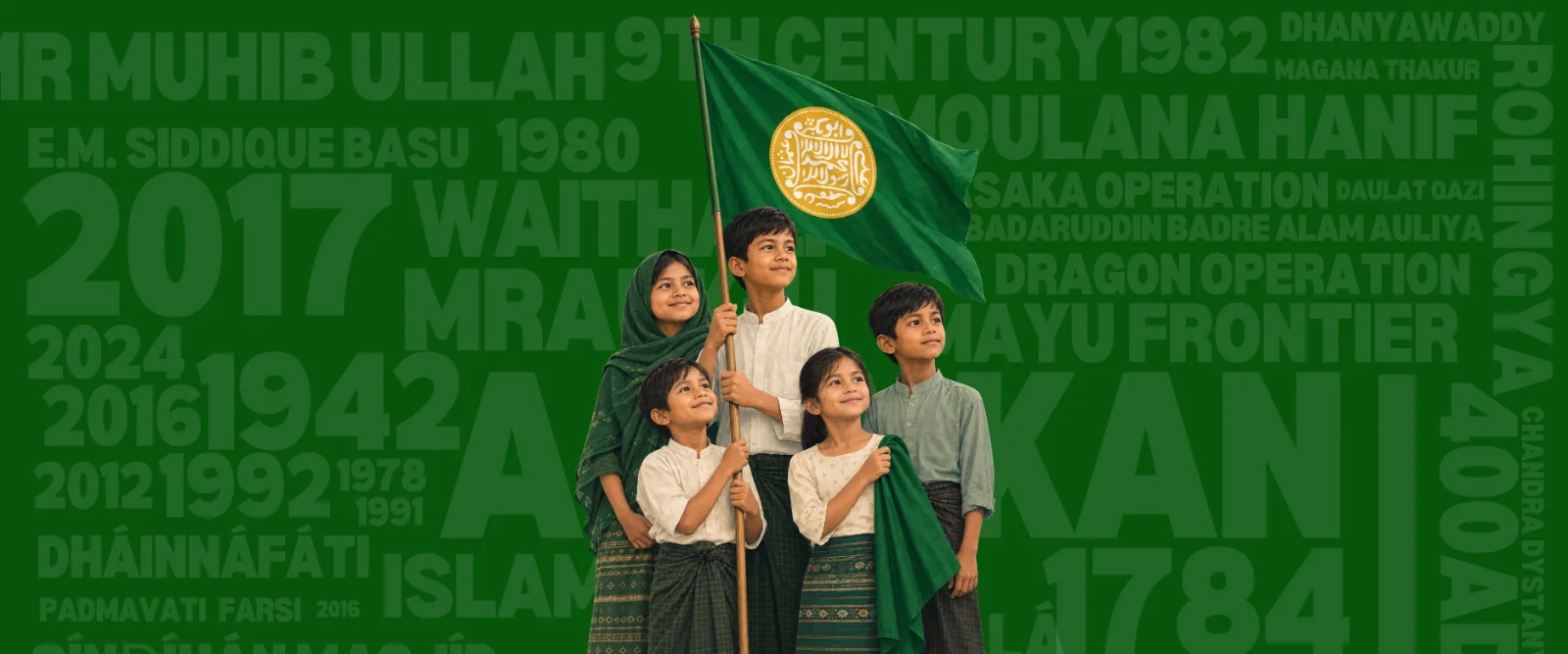
Scholar, Linguist, Educator, and Father of the Rohingya Script
Sheikh Muhammad Hanif Ragheb Arkani, widely known as Moulana Mufti Muhammad Hanif, was one of the most influential Rohingya intellectuals and Islamic scholars of the modern era. A distinguished jurist, linguist, educator, author, and cultural reformer, he devoted his life to Islamic scholarship, education, and the preservation of Rohingya linguistic and cultural identity. He is most prominently remembered as the creator of the Hanifi Rohingya script, a historic contribution that earned him recognition as the “Father of the Rohingya Script.”
Early Life and Family Background
Sheikh Muhammad Hanif was born in 1952 CE (1371 AH / 1164 Rohingya Era) in the village of Firing Daung, located northwest of Rathidaung Township in Arakan, present-day Rakhine State, Myanmar. He was born into a respected scholarly family and was the son of Wali Ahmed, grandson of Turab Ali, and great-grandson of Nurud Din.
From an early age, he demonstrated exceptional intellectual ability, spiritual depth, and a profound passion for knowledge. His upbringing in a religious environment greatly shaped his lifelong dedication to scholarship and community service.
He was later blessed with nine children: three sons — Professor Hassan Hanif, Professor Emran Hanif, and Professor Ebrahim Hanif — along with six daughters.
Academic Life
Sheikh Muhammad Hanif began his early education at Qasim al-Ulum Friending School before continuing his studies at Rahmaniyah School. There, he studied under renowned scholars including Sheikh Din Muhammad (Shaheed) and Sheikh Maulana Abdul Haq, building a strong foundation in Arabic grammar, Islamic sciences, and classical literature.
Driven by an unwavering pursuit of knowledge, he continued his higher Islamic studies at several prestigious institutions, including:
Darul Uloom Miyajanpur
Moin al-Islam Hathazari
Zamiriyah Qasim al-Ulum Youth University
In 1977, he successfully completed his Daurah Hadith, marking the completion of advanced Islamic scholarship. He later specialized in Islamic jurisprudence and, in 1981, earned the qualification of Mufti from Dar al-Iftaa, Karachi.
In his later years, he also attained the honor of becoming a Hafiz al-Qur’an, memorizing the Holy Qur’an with proper tajweed and devotion.
Creator of the Hanifi Rohingya Script
Among Sheikh Muhammad Hanif’s greatest contributions was his historic effort to preserve the Rohingya language. During his years as a student, he realized that the Rohingya people lacked a standardized writing system capable of accurately representing their language and safeguarding their cultural heritage.
Motivated by this concern, he dedicated himself to developing an original script specifically designed for the Rohingya language. In 1982, he successfully introduced the Hanifi Rohingya script — a unique and systematic writing system carefully developed to reflect Rohingya phonetics, pronunciation, and linguistic structure.
His achievement marked a turning point in Rohingya cultural history. The Hanifi script later emerged as a powerful symbol of Rohingya identity, resilience, and linguistic preservation. Today, it continues to be taught in educational institutions and used in literature, cultural initiatives, research, and digital communication platforms around the world.
Scholarship, Teaching, and Literary Contributions
Throughout his life, Sheikh Muhammad Hanif remained deeply committed to teaching, research, and institution building. His educational and scholarly activities extended across various regions, including Maungdaw, Akyab, Karachi, and Cox’s Bazar, where he mentored students and contributed to the intellectual development of the Rohingya community.
Among his major institutional contributions were the establishment of:
Dar al-Tarbiyah Islamic School (1985)
Islamic Postgraduate Studies and Research Complex (2002)
In addition to his educational leadership, he was also a multilingual author who wrote extensively in Arabic, Persian, and Urdu. His published works include:
Quiliyat Ragheb
Izhar-e-Haqiqat
The Call of Truth
The Problem of Arakan and Its Solution
His writings reflected intellectual depth, religious conviction, and a profound concern for the future, dignity, and survival of the Rohingya people.
Influence
Sheikh Muhammad Hanif was widely respected for his humility, wisdom, eloquence, and sincerity. He possessed extensive knowledge in Islamic jurisprudence, theology, literature, linguistics, and poetry. Throughout his life, he remained devoted to teaching, issuing religious guidance, mentoring students, and serving society with integrity and compassion.
His influence extended far beyond academic circles. He inspired generations of students, scholars, writers, educators, and cultural activists, leaving a lasting imprint on Rohingya intellectual and cultural life.
Legacy
Sheikh Muhammad Hanif Ragheb Arkani passed away on Friday, 10 November 2023 at Dar al-Sunnah University in Cox’s Bazar.
His funeral prayer was attended by thousands of mourners, reflecting the immense respect and admiration he commanded among the Rohingya people and the broader Muslim community. He was laid to rest in Safrang, Nowa Farah.
Today, Sheikh Muhammad Hanif is remembered as one of the most important figures in modern Rohingya history. His lifelong dedication to scholarship, education, language preservation, and cultural identity continues to inspire Rohingya communities and future generations across the world.
His legacy endures not only through his writings and institutions, but also through the Hanifi Rohingya script — a lasting symbol of a people’s language, identity, and historical continuity.
-Anis Mostofa